“Most companies are running AI experiments. Very few are running an AI business.”
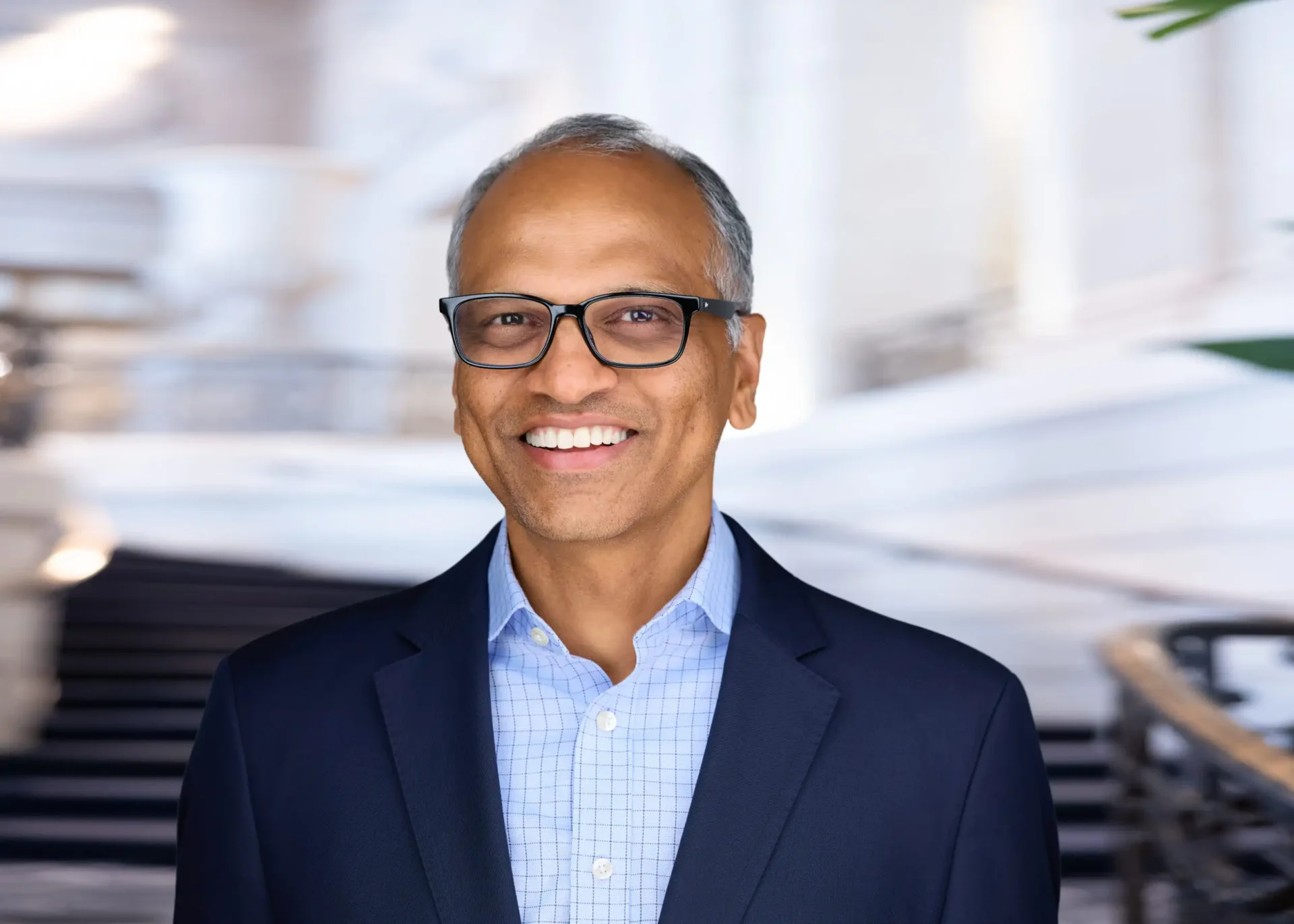
Founder and CEO, RoAI Institute

The Executive Framework for AI Transformation
You've invested in AI. You have the infrastructure, the talent, and the pilots. So why isn't the value showing up where it matters? RoAI-O₂S is the operating system built to answer that question and close the gap.
Laks Srinivasan has spent more than a decade working inside the AI transformations of over 100 enterprises. He has seen what separates the organizations that scale AI successfully from those that stay stuck in pilot purgatory. His conclusion: the technology is rarely the problem.
“Most companies are running AI experiments. Very few are running an AI business.”
The missing piece is always a system: a clear, repeatable way to connect AI capability to business value. RoAI-O₂S is that system. It gives VPs and senior leaders the operating system to move from experimentation to measurable, scalable ROI.
Yet these are exactly the steps most organizations take when they decide to “invest in AI.” The assumption is that if built, capability will eventually find its way to value. It rarely does. Technology-first thinking treats AI as the answer before anyone has defined the question. It produces impressive infrastructure, a growing headcount, and diminishing returns.
The companies pulling ahead are not the ones with the most sophisticated technology. They are the ones who decided what value they needed to create and then built only what was required.
Technology-First (Inside-Out)
Select a platform
Build models
Scale data science team
Hope the business adopts output
Outcome-First (Outside-In)
Define business outcomes
Identify the decisions that drive them
Build only what supports those decisions
Measure against outcomes from day one
That shift, from technology-first to outcome-first, is where AI transformation becomes real. You don’t start building a house by picking out fixtures. You start with the foundation. AI transformation works the same way, and the organizations that skip that crucial step are the ones rebuilding from scratch two years later.
Think of RoAI-O₂S as the operating system your AI transformation has been missing. Just as an operating system connects hardware to software and makes everything work together, RoAI-O₂S connects AI capabilities to business outcomes, giving every initiative a clear purpose, a governance structure, and a path to measurable ROI.
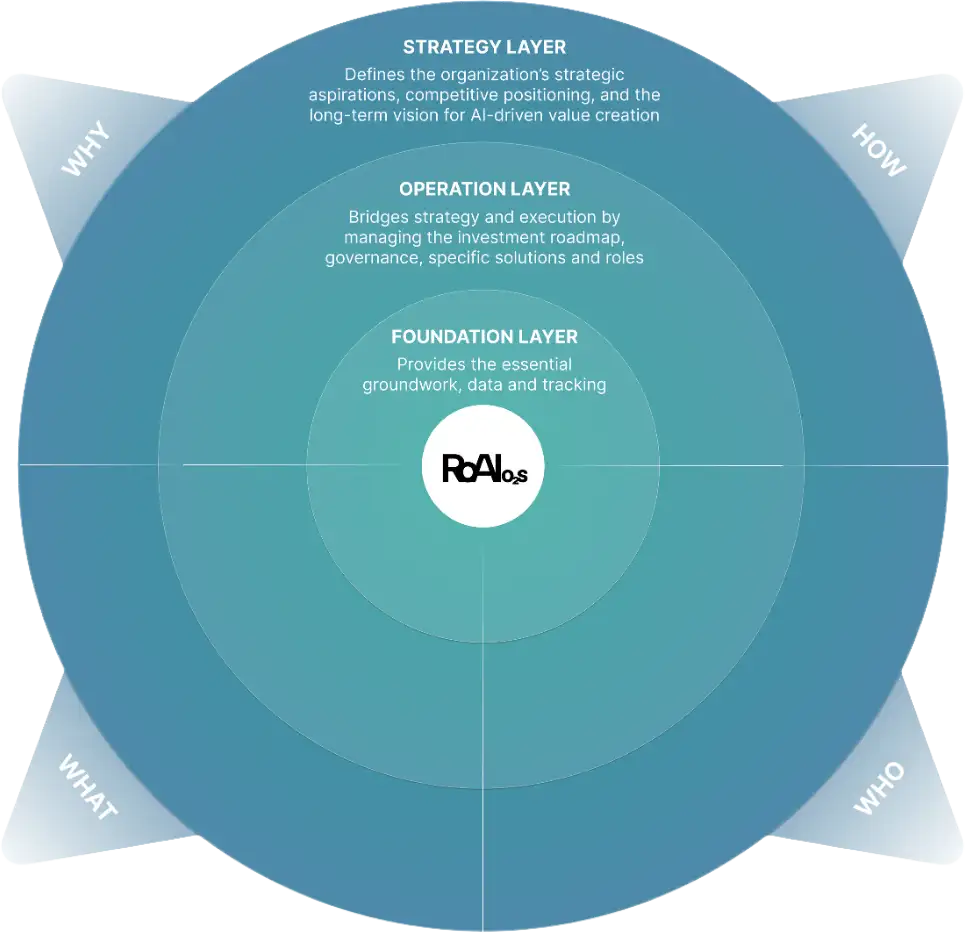
What makes RoAI-O₂S different is its direction. Most organizations build from the inside out: starting with technology and hoping strategy catches up. RoAI-O₂S works from the outside in. Strategy first. Capability second. Technology last.
Successful AI transformation doesn’t fail in just one place. It breaks down across strategy, execution, technology, and people. RoAI-O₂S addresses all four dimensions at once, because fixing one without the others doesn’t move the needle.
The foundation of everything.
Defines your AI vision, competitive ambition, and value creation thesis. Without a clear answer to "why," AI initiatives become technology searching for problems. This dimension provides direction for every subsequent decision.
Where strategy becomes real.
Covers governance, portfolio management, ecosystem partnerships, and operational methodology. This is the dimension that translates strategic intent into a system that can run consistently, at scale, and with accountability.
The tools to deliver.
Addresses technology choices, data infrastructure, AI solutions, and integration architecture. The technical stack exists to serve the strategy, not to define it. This dimension ensures your capabilities are built for the outcomes you've already committed to.
The dimension most organizations underinvest in.
Covers organizational culture, role design, AI fluency, and change management. The WHO dimension is where transformations are won or lost.
Most AI programs address one or two of these dimensions well. RoAI-O₂S integrates all four because that’s what it takes to run an AI-first business. Which of these dimensions is holding your organization back?
Most executives find that one or two of these answers stop them in their tracks. That’s the point. Knowing where the gap lives is the first step toward closing it.
Your foundation is strong.
The opportunity now is to differentiate through competitive strategies: optimizing your portfolio, exploring agentic AI, and ensuring your strategic vision keeps pace with technology evolution. The Executive Guide shows you how leading organizations stay ahead.
You've built something real, but scaling it is proving harder than building it.
Defines your AI vision, competitive ambition, and value creation thesis. Without a clear answer to "why," AI initiatives become technology searching for problems. This dimension provides direction for every subsequent decision.
You're not behind, but you're at the beginning.
Recognizing that is an act of strategic clarity, not failure. The organizations that start with the right framework move faster and waste less. The Executive Guide is your starting point.
RoAI-O₂S isn't a multi-year theory. It's a structured operating system with a clear starting point and a concrete path to your first measurable outcomes in 90 days. Executed across industries from global technology companies aligning 150 senior leaders on AI execution direction, to NYSE-listed enterprises building board-level AI governance from the ground up. The roadmap is not hypothetical. It's been run, refined, and repeated.
Weeks 1–4
Align leadership. Define your AI vision. Build the business case. This phase is anchored by the RoAI O₂S maturity assessment and the development of your AI value-creation thesis: the explicit connection between your AI ambition and your business outcomes.
Weeks 5–8
Stand up governance. Launch your first project. Start building fluency. This phase establishes your AI Council structure, defines decision rights, and activates the Money Map to connect your first initiative to a measurable financial outcome.
Weeks 9–12
Document ROI. Approve the 12-month roadmap. Launch the next wave. This phase uses the Circle-to-Diamond framework to identify where your next highest-value AI investments should go and builds the organizational fluency required to sustain progress without external dependency.
By the end of 90 days, your organization won’t just have a strategy on paper. It will have a governance structure that works, a financial tracking system that connects AI to outcomes, and proof, in the form of a completed project with measurable results, that the operating system delivers.
RoAI-O₂S is built for VPs, Senior Directors, and executive leaders responsible for AI strategy, transformation, or business outcomes who are frustrated that AI investment isn’t translating into measurable results. It’s designed for leaders who need a system, not just a technology recommendation.
RoAI-O₂S methodologies and leading principles have been applied across organizations of all sizes, from mid-market companies building their first AI capabilities to large enterprises optimizing their existing AI portfolios. The framework adapts to your level of maturity. The starting point changes, but the system is the same.
Most AI frameworks focus on technology: which platforms to use, how to build models, or how to manage data. RoAI-O₂S starts with business value and works backward to technology. It’s the only framework that simultaneously addresses strategy, governance, technical capability, and organizational readiness as an integrated system. It’s also practitioner-built, developed and refined through 100+ real-world AI transformations from the RoAI Institute.
Most consulting engagements optimize for deliverables and most training programs optimize for individual knowledge. Neither addresses the actual failure point: the gap between AI insights and business decisions, and the organizational fluency required to close it. RoAI-O₂S is built around team-based transformation, not individual education. Every leader on your team develops a shared framework, a common vocabulary, and the decision-making capability to act on AI insights. The result is organizational fluency that doesn’t leave when the engagement ends.
RoAI-O₂S delivers measurable results in 90 days. That includes a board-approved AI vision and ambition, a quick-win project in production, and a 12-month roadmap approved and ready to execute. Longer engagements, typically 6 to 12 months, are available for organizations that want full implementation support beyond the initial sprint.
The 90-day engagement covers all three layers of the RoAI O₂S framework: establishing a strategic vision and value-creation thesis, standing up portfolio governance and an AI Council, launching a quick-win project with measurable outcomes, assessing platform and data foundations, and scaling AI fluency across the organization. The full week-by-week breakdown is included in the Executive Guide.
Yes. RoAI-O₂S works with any technology platform, cloud provider, or AI stack. The framework is built around business strategy and organizational capability, not around any specific vendor or tool. Your existing technology investments don’t need to change for RoAI-O₂S to work.
RoAI O₂S includes the Money Map: a proprietary financial framework that connects AI investments directly to business value drivers and tracks returns over time. It covers budgeting models, ROI calculation methodologies, cost allocation, and value measurement. From day one, every initiative is tied to a financial outcome, not just a technical milestone.
RoAI-O₂S meets you where you are. The maturity assessment identifies which layer of the framework needs the most attention, given your current state. If you already have pilots running, the framework helps you govern, prioritize, and scale what’s working, and make clear decisions about what isn’t.
The RoAI O₂S Executive Guide gives you everything you need to move from AI investment to AI value. It's a practical, practitioner-built resource designed for leaders who are done with experiments and ready for results.
100+ organizations transformed
Applied across 32+ industries
Technology agnostic
form code goes here